
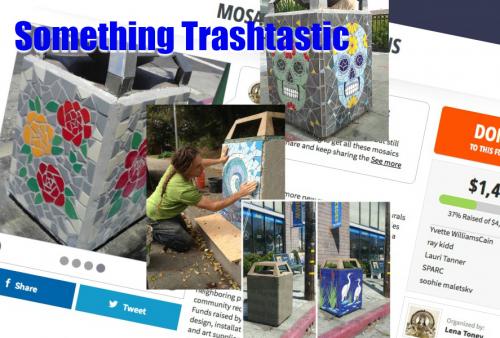
Did you ever stop and think about the importance of trash cans? Seriously. Garbage receptacles on city corners are something we just take for granted. But really, they are a gift from our government. I can’t tell you the number of times I’ve been walking down the street with something I need to toss. When I can’t find a receptacle it can be downright aggravating. Recently, they removed the trash bins from my Costco gas station and I gotta tell you, it’s a bummer. My refueling ritual used to include disposing of the random bits of streamers, bills of sale, and order forms that litter my front seat after a weekend of events. Now I’ve got to actually make time for cleaning out my car. Their recent removal has made me hyper aware of just how important communal trash receptacles are.
This is all leading to telling you about why, when I received an e-mail from long time friend and fabulous face painter Lena Toney about funding a trash can mosaic program in Oakland, I felt an immense desire to not only help, but to spread the good word about what she and other like minded artists are doing to help perk up these often overlooked necessities. I originally hail from Philadelphia, a city that famously embraces community art, so the thought of these bright and beautifully designed dustbins makes my heart beat faster.
I asked Lena to answer a few questions about the project, it’s origins, and how others can get involved.
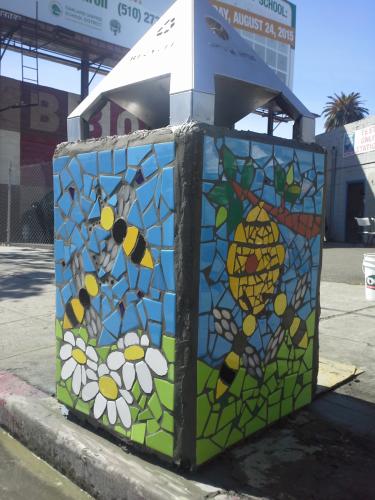
When did you first conceive of this project and what was the inspiration behind the program? The project initially started with painted garbage cans as a way to try something more appealing than the brown cubes often covered in not very aesthetically inspiring tagging (graffiti) that the city provided. A friend of mine knew someone on the City Council (council member Lynette McElhaney) and told me I should email her to apply to be one of the artists to paint garbage cans with mini murals as part of a community clean up day the council member was hosting. I had never tried to paint in a public space before or on such a large scale. It was much easier in my head than when I got to the site to do the work. I had to simplify the design a lot. The surface of the garbage can is too textured for detailed designs. The painted garbage can was met with a lot of community support and grew to a total of five painted garbage cans. After the five painted ones, community members requested that I try to do some of the mosaic garbage cans we see in other parts of Oakland. You can read about that amazing legacy of which we are now a part here.
I first learned how to do the mosaics from a crash course in mosaic art with an amazing master mosaic artist, Juan Lopez of New World Mosaics. In addition, I have a small team of dedicated voluteers. Without their help this would definitely not be possible. The first two mosaics were paid for by East Bay Asian Local Development Corporation. The third and fourth mosaic were paid for by a grant I received from the West Oakland Mini Grant Committee. Now we are trying a Crowdrise campaign to pay for a few more.

2. Who is involved in the project? The lead group is myself, a few dedicated volunteers, Annie, all of our donors, and community residents. I would also say the City of Oakland is very verbally supportive of the projects.
3. How are the receptacles/ locations chosen? Combination of community input, safety of volunteers, ability to maintain, and being mindful of city plans to replace receptacles with streetscaping improvements in the next few years (The painted ones are all supposed to be replaced in the next year or two. They have been painted for about two years now).
4. How are the designs chosen? Combination of community input and artist ability/choice. Also, feedback from the city since they are on public space.
5. About how many hours go into each receptacle? A lot, it takes approx 40 hours or more just to assemble the mosaics. That doesn't include the installation (about 10 hrs for install), design, funding, community input, etc.
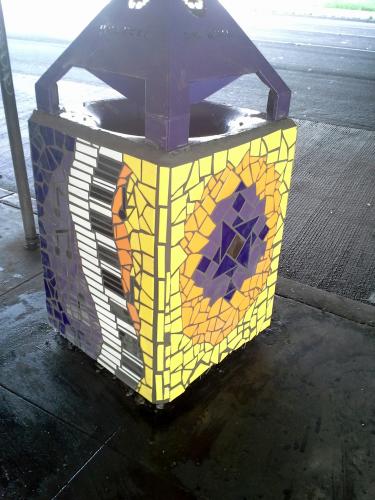
6. What are the steps in making one of the fabulous creations? Funding, community outreach, design, assemble, community outreach, install with community support, maintenance.
7. Are there a lot of political hoops to jump through to do something like this? The City of Oakland tries to make it easy through the adopt a spot program. Other political hoops can be encountered with nearby residents and how funding is obtained.
8. How does one go about setting up a "beautification" program such as yours? That's a great question. We seemed to have formed organically. I think starting with a common project multiple people want to address is a good way to begin.
9. Is there a website about your project so folks can learn more about the project? Not a single website, but the Crowdrise campaign and The Bold Italic article give a great amount of info.
Oakland is an amazing City, and the people who live there are dedicated to showing the world just how wonderful it is. If you’ve got a few moments to spare, I encourage you to check out the video link which highlights the process of creating one of these amazing “trash-terpieces”. If you are anything like me, you’ll be blown away by the dedication, skill, and love that these volunteer artists put into making something ordinary extraordinary.
